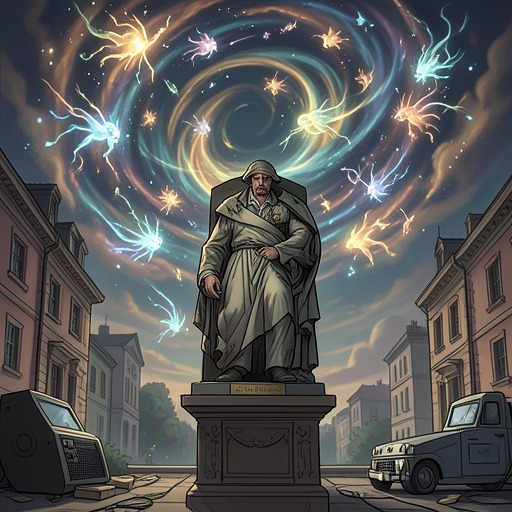
The Wonder and Inexplicability of Creation
Book of JobThe Wonder and Inexplicability of Creation is the Book of Job’s central counter to the demand that the universe be made intelligible as a neat moral system. In the interpretation offered by the book’s introduction, God does not answer Job’s questions by explaining why suffering has occurred. Instead, the divine speeches turn attention toward a world too various, immense, and strange to be measured by human expectations. Its mystery does not supply a full solution to suffering; it changes the terms of the inquiry, making the limits of human knowledge part of what the poem asks its readers to confront.
From Moral Order to an Unruly World
The introduction sets this vision against the arguments of Job’s friends, who try to defend the universe as a rational and consecutive pattern. Their comfort depends on the confidence that events fit together in an intelligible order. The divine answer overturns that confidence: the world’s value, in this reading, does not lie in being explainable. Its workings repeatedly exceed the human mind, and some of its processes appear to serve no visible human purpose at all.
This reversal matters because Job’s dispute is not simply whether suffering can be fitted into a doctrine. The introduction presents the Book of Job as asking whether God’s purpose is worth the human cost, and whether human beings can know what that purpose is. The friends defend God through general assurances about order; the divine speech refuses to validate their method. Creation becomes evidence not for a system Job can master, but for the inadequacy of the demand that every part of existence be made legible to him.
The Divine Cross-Examination
When God answers Job from the whirlwind, the form of the encounter sharpens the idea. The human characters have been asking questions of God, but God enters by asking questions in return. The introduction describes this as a reversal of the expected debate: rather than solving Job’s riddles, God puts the questioner’s own knowledge under examination. Job is made to consider the distance between his judgments and the scale of the world about which he judges.
That reversal is not presented as a simple prohibition on questioning. The introduction interprets the speech as turning skepticism back upon itself: the more thoroughly human beings test their assumptions, the more they may discover that their own standpoint is uncertain. God’s questions do not provide Job with the hidden explanation of his misfortunes. Their force lies instead in revealing how little human beings can claim to know about the larger processes they would use to explain them.
The speech also differs from the friends’ defenses in what it does with uncertainty. Their reasoning seeks reassurance through an account in which everything fits. God’s response, as the introduction reads it, makes the world’s resistance to explanation part of its wonder. The change is therefore both intellectual and dramatic: the argument moves from competing human accounts of justice to an encounter with a creation that exceeds the categories those accounts rely on.
A Catalogue of Strange Particulars
God’s answer gives that claim concrete form through a sweeping catalogue of natural phenomena and creatures. It asks about rain falling in a wilderness where no person is present, and about the origins of dew and ice. Such examples direct attention to processes that are not arranged simply around human observation or use. Rain can nourish desolate ground beyond the settled world; the question of who fathers it or brings forth ice points toward origins that human beings cannot command.
The catalogue also ranges across animals, presenting the Horse, Eagle, Raven, Wild ass, Ostrich, Behemoth, and Leviathan as beings whose force and habits resist reduction to familiar measures. The introduction describes this passage as a panorama of created things, each rendered striking enough to seem almost monstrous in the sunlight. Its effect is not to establish a zoological argument but to intensify the reader’s sense of a world whose inhabitants and powers cannot be made ordinary merely by naming them.
In the introduction’s account, the passage works like a rhapsody of wonder: the maker speaks of creation with an astonishment that makes the world feel newly unfamiliar. The rain in an empty wilderness and the creatures beyond human control are not incidental ornaments to an otherwise abstract argument. They are the argument’s particular evidence. The creation Job encounters is not a diagram of human justice; it is a field of processes and lives whose existence does not depend on human comprehension.
Mystery, Judgment, and a Limited Hope
The introduction draws a distinction between the friends’ confidence in a rationally explained universe and the divine speech’s emphasis on inexplicability. Yet it does not interpret the speech as sheer despair. Some of its images allow intimations of a brighter purpose to appear without turning that purpose into a disclosed plan. The Sons of God, for instance, are recalled as shouting for joy at the laying of the world’s foundations. Snow and hail are described as a treasury kept for a day of battle, which the introduction reads as a possible hint of a future struggle against evil.
These suggestions remain glimpses rather than explanations. The introduction compares them to light appearing through the cracks of a closed door: they permit an optimistic possibility while preserving the speech’s refusal to make God’s design transparent. Hope is present as an implication in the imagery, not as a complete account of why Job has suffered or how every element of the world fits into a final scheme.
The divine response also rebukes both sides of the human argument. Job has challenged God, while his friends have defended God with confident explanations; the introduction stresses that neither accusation nor mechanical reassurance escapes the limits exposed by the speech. Job is nevertheless comforted after hearing it, although he has not been given the requested explanation. The poem’s distinction is consequential: an encounter with what cannot be explained may change Job’s relation to mystery without resolving the mystery itself.
The concept thus joins intellectual humility to a vivid attention to the created world. In the introduction’s reading, creation is not offered as a transparent proof that suffering is just, nor as a blank chaos without meaning. It is a reality whose particulars exceed human purpose and understanding, while its imagery leaves room for intimations of joy and the defeat of evil. The Book of Job’s answer is not a final theory of the world, but an enlargement of what Job must reckon with: the unknown is not merely a gap awaiting human explanation; it is a defining condition of creation.